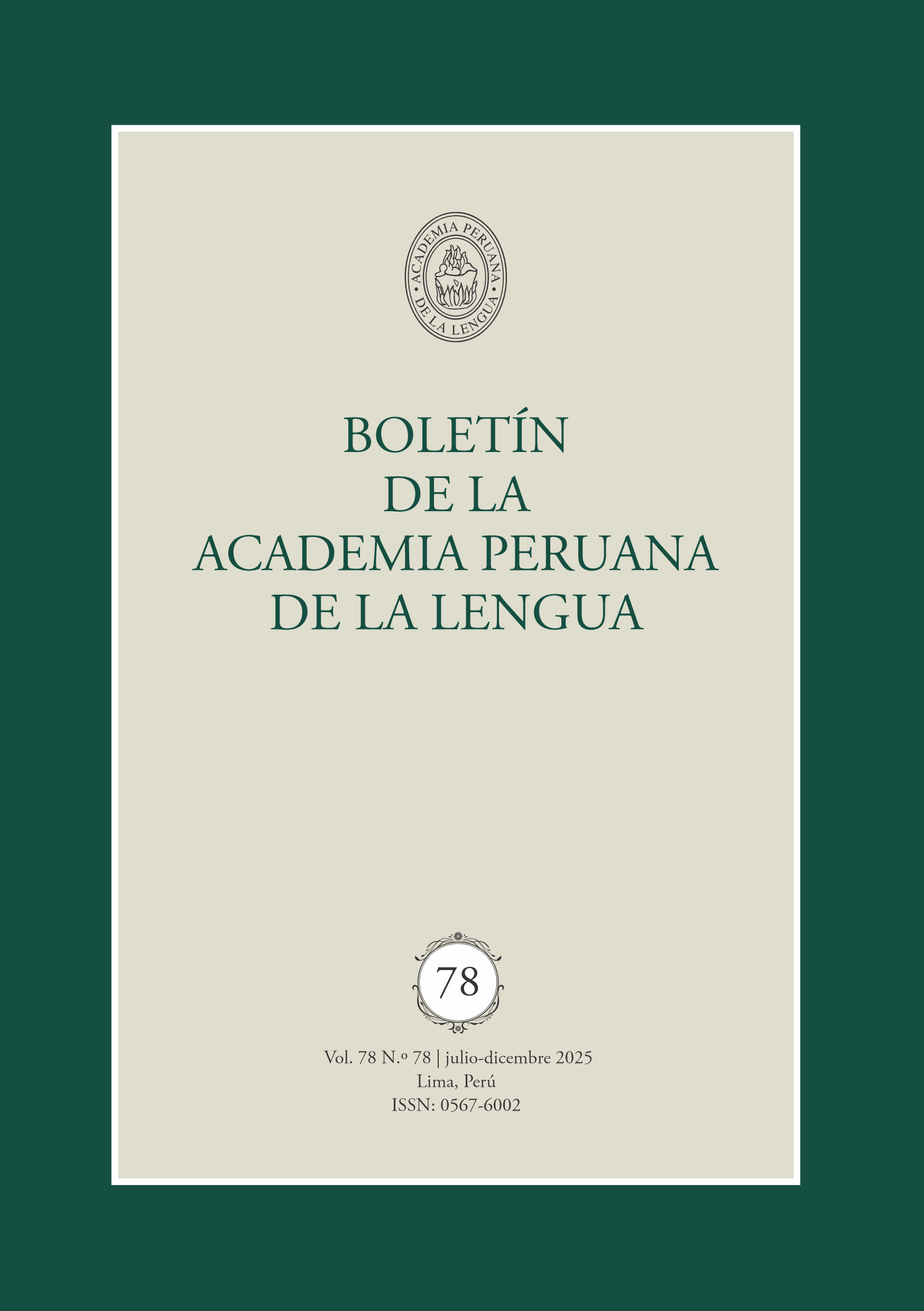
Innovative pronominal constructions: a comparison via the PRESEEA-Lima corpus
-
Anahís Samamé Rispa
Ohio State University
.gif) https://orcid.org/0000-0002-7079-3873
https://orcid.org/0000-0002-7079-3873
Abstract
This preliminary study compares the use of Peruvian Spanish pronominal constructions among two groups of speakers in the city of Lima: descendants of Andean migrants and non-descendants of Andean migrants. Using a sample of data from the PRESEEA-Lima corpus, we analyze the canonical uses of pronominal constructions, as well as those uses that involve innovations with verbs not characterized as canonically pronominal. The analysis of sixteen interviews from the corpus shows that speakers from the group with Andean ancestry produce innovative pronominal constructions not found in the variety spoken by speakers without recent Andean ancestry. Furthermore, compared to the non-Andean group, the former use unstressed personal pronouns more frequently with alternating pronominal verbs. It is concluded that both the innovative uses and the higher frequency of pronominal constructions with alternating verbs are features of the Spanish spoken by the descendants of Andean migrants and can be explained as a case of linguistic convergence.
Downloads
Copyright (c) 2026 Anahís Samamé Rispa

This work is licensed under a Creative Commons Attribution 4.0 International License.
Authors retain their rights:
a. The authors retain their trademark and patent rights, as well as any process or procedure described in the article.
b.The authors retain the right to share, copy, distribute, perform and communicate publicly the article published in the Boletín de la Academia Peruana de la Lengua (for example, placing it in an institutional repository or publishing it in a book), with an acknowledgment of its initial publication in the Boletín de la Academia Peruana de la Lengua.
c. Authors retain the right to make a subsequent publication of their work, to use the article or any part of it (for example: a compilation of their work, notes for conferences, thesis, or for a book), as long as they indicate the source of publication (authors of the work, journal, volume, number and date).